太阳成8722Hytran Biotechnology Co., Ltd.
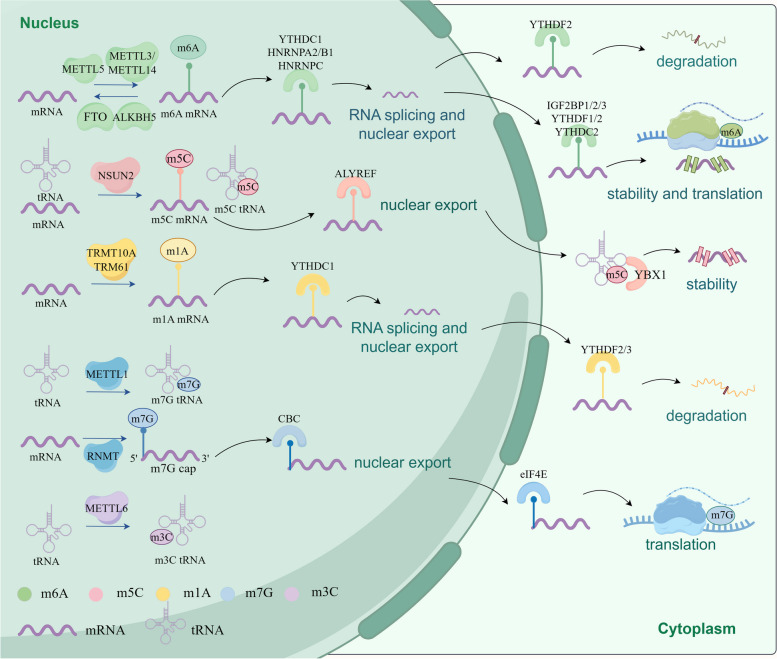
甲基化修饰(Methylation)RNA甲基化是指将甲基基团共价添加到RNA核苷酸上的修饰方式,对RNA稳定性、定位、运输、剪切和翻译等发挥重要的作用。根据修饰位置,RNA甲基化类型分为m6A,m1A,m3C,m5C,m7G和2’-O-me等。RNA甲基化是一个动态调控过程,三类关键蛋白参与其中:甲基转移酶(Writer),负责将甲基基团共价添加到RNA核苷酸上;去甲基化酶(Eraser),负责把甲基基团从RNA核苷酸上移除;甲基识别蛋白(Reader),负责识别甲基基团并发挥作用1。不同RNA甲基化类型的调控蛋白可见表1。 RNA methylation refers to the modification process where methyl groups are covalently added to RNA nucleotides, playing a crucial role in RNA stability, localization, transportation, splicing, and translation. Based on the modification location, RNA methylation types are classified into m6A, m1A, m3C, m5C, m7G, and 2'-O-me. RNA methylation is a dynamically regulated process involving three key proteins: Writer, responsible for covalently adding methyl groups to RNA nucleotides; Eraser, responsible for removing methyl groups from RNA nucleotides; and Reader, responsible for recognizing and exerting the function of methyl groups1. The regulatory proteins for different RNA methylation types are shown in Table 1.
图1 RNA甲基化机制示意图1 Fig.1 Schematic diagram of molecular mechanisms for RNA methylation1 表1 RNA甲基化调控蛋白 Table 1 The regulator proteins of RNA methylations
检测方法(Methods)
应用(Application) 1. 确定靶RNA甲基化(Identification of target RNA methylation); 2. RNA修饰测序(Sequencing of modified RNAs)。 客户提供的材料与信息(Materials and information provided by customers): 1、目的RNA信息(Target RNA information); 2、细胞样本(Cells):不低于2×10^7个细胞(No less than 2×10^7 cells); 3、组织样本(Tissues):不低于1g(No less than 1g)。 参考文献(Reference) 1 Li, Y. et al. The role of RNA methylation in tumor immunity and its potential in immunotherapy. Mol Cancer 23, 130 (2024). https://doi.org/10.1186/s12943-024-02041-8 下一篇RNA修饰检测
|