太阳成8722Hytran Biotechnology Co., Ltd.
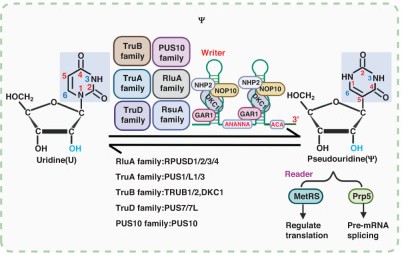
假尿嘧啶化(Pseudouridylation)假尿嘧啶(Ψ)是尿嘧啶的旋转异构体,几乎存在于所有类型的RNA中。假尿嘧啶化是最丰富的RNA修饰,对RNA稳定性、RNA-RNA互作、RNA-蛋白质互作、RNA剪切、翻译和tRNA衍生片段(tRF)生成等发挥重要的作用。假尿嘧啶化是一个不可逆的过程,两类关键蛋白参与其中:假尿嘧啶合成酶(Writer),负责合成假尿嘧啶;修饰识别蛋白(Reader),负责识别假尿嘧啶并发挥作用1。假尿嘧啶化的调控蛋白可见表1。 Pseudouridine (Ψ) is a rotational isomer of uracil, present in almost all types of RNA. Pseudouridylation is the most abundant RNA modification and plays a crucial role in RNA stability, RNA-RNA interactions, RNA-protein interactions, RNA splicing, translation, and the generation of tRNA-derived fragments (tRFs). Pseudouridylation is an irreversible process involving two key proteins: pseudouridine synthase (Writer), responsible for synthesizing pseudouridine, and modification recognition protein (Reader), responsible for recognizing pseudouridine and exerting its function. The regulatory proteins involved in pseudouridylation are shown in Table 1.
图1 假尿嘧啶化机制示意图1 Fig.1 Schematic diagram of molecular mechanisms for pseudouridylation1 表1 假尿嘧啶化调控蛋白 Table 1 The regulator proteins of pseudouridylation
检测方法(Methods)
应用(Application) 1. 确定靶RNA假尿嘧啶化(Identification of target RNA pseudouridylation); 2. RNA修饰测序(Sequencing of modified RNAs)。 客户提供的材料与信息(Materials and information provided by customers): 1、目的RNA信息(Target RNA information); 2、细胞样本(Cells):不低于2×10^7个细胞(No less than 2×10^7 cells); 3、组织样本(Tissues):不低于1g(No less than 1g)。 参考文献(Reference) 1 Tang, Q. et al. RNA modifications in cancer. Br J Cancer 129, 204-221 (2023). https://doi.org/10.1038/s41416-023-02275-1 |